 Team-Trak
Get Paid Faster: A Practical Guide for Service Firms
 By Bob Fitzjohn8 min read
Learn how to get paid faster from clients with a clear work-to-invoice handoff, accurate records and a steady follow-up routine that reduces billing delays.

In this article
What if getting paid faster started before you sent the invoice? When completed visits sit in a manager’s inbox, or time records need rebuilding from messages and paper sheets, billing slips and questions become harder to resolve. To get paid faster from clients, you need a clear handoff from completed work to accurate invoice, with useful proof ready when a client asks.
It’s frustrating to finish the work and still spend Friday matching handwritten hours against WhatsApp messages before you can bill for it. This guide lays out a practical process you can use to send invoices promptly, reduce approval questions and follow up consistently without turning payment reminders into a strained client relationship. You’ll see how to capture visit details, check invoice accuracy and set a simple routine for overdue accounts.
Key Takeaways
- To get paid faster from clients, make the handoff from finished work to invoice clear and timely.
- Set payment terms and an approval route before work begins, so there’s less uncertainty when billing.
- Choose a record-keeping method that fits your job volume, then use it consistently to capture completed work.
- Build a simple review and follow-up routine to resolve invoice questions without letting overdue accounts slip.
Table of Contents
Why service businesses wait to get paid by clients
A client questions whether a visit happened, or how long the team stayed. You know the work was done, but the record is incomplete: the job note is late, the hours are missing, or the person who can approve the visit is unclear. Without those details, it’s difficult to issue an accurate invoice or answer the client with confidence.
This is a familiar field-service delay. The work may be finished while you’re still rebuilding its record from WhatsApp messages, handwritten notes and staff recollections. A short gap in the visit record can become a longer pause while someone checks what happened, confirms billable time and seeks approval. Clear records help resolve questions before they turn into invoice disputes, rather than leaving the client to piece together the service history.
Where the delay enters the job-to-payment chain
Every handoff can add waiting time: a team member records the completed visit, a manager reviews exceptions, the invoice is prepared and sent, then the client processes payment. If the staff record arrives late or lacks start and finish times, the manager may need to chase details before approving it. If the approval route isn’t clear, the invoice can sit even when the work itself is undisputed.
Separate internal billing lag from client payment time. If work was completed on Monday but the invoice isn’t sent until the following week, the delay began in your own admin. If an accurate invoice was sent promptly but remains unpaid past its terms, the wait is with the client. Both affect cash flow and managing accounts receivable, but they need different fixes.
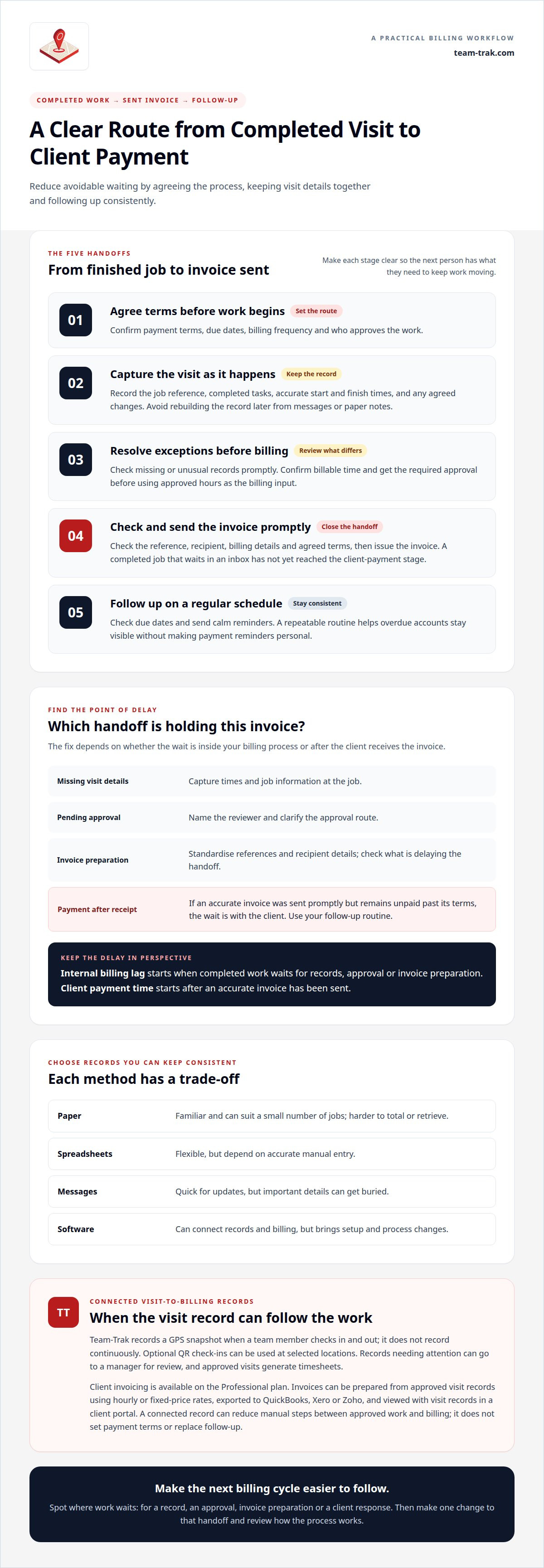
To get paid faster from clients, first identify which handoff is holding each invoice: missing visit details, pending approval, invoice preparation or payment after receipt. For practical ways to improve the wider cash-flow process, see this guide to improving cash flow for service businesses.
How to get paid faster from clients after field work
To get paid faster from clients, make the route from finished job to payment predictable. Start with agreed terms, then keep visit records, invoice details and follow-ups consistent. The aim is fewer avoidable delays, not a promise that every client will pay sooner.
A repeatable workflow from completed visit to sent invoice
Set payment terms and confirm who approves work before the first visit. Record the job reference, completed tasks and accurate start and finish times as the work happens, rather than rebuilding them later. Review exceptions promptly, then use approved hours as the billing input. This guide to timesheet automation explains how approved time records can support that handoff.
- Agree terms: Confirm due dates, billing frequency and the client’s approval route.
- Capture work: Record visit times, job details and any agreed changes.
- Review exceptions: Resolve missing or unusual records before invoicing.
- Send promptly: Check the reference, recipient, billing details and terms, then issue the invoice.
- Follow up: Keep a regular schedule for checking due dates and sending calm reminders.
Choose records that fit your workload. Paper is familiar and can suit a small number of jobs, but it may be harder to total or retrieve. Spreadsheets are flexible, though they rely on accurate manual entry. Messages are quick for updates but can bury key details. Software can connect records and billing, but brings setup and process changes.
Use the bottleneck to choose the next step: missing visit times, capture them at the job; approval delays, name a reviewer; invoice questions, standardise references and recipient details; overdue balances, schedule follow-ups. The SBA financial management guidelines also cover financial routines for small firms. Reviewing these handoffs regularly can help you spot where your own process needs attention.
Turn verified visits into clearer client invoices
A record that follows the work can reduce manual handoffs between a completed visit and a bill. The useful test is whether the details needed to prepare and explain an invoice are available without rebuilding the job history.
When a verified-visit workflow fits your billing process
Team-Trak starts with scheduled jobs. When a team member checks in and out, a GPS snapshot is recorded at each point, not continuously. QR check-ins are optional and can be used at selected locations.
Records that need attention go to a manager for review. Most visits can proceed through the workflow without individual approval, while exceptions such as a missed or out-of-range check-in can be reviewed. Once approved, verified visits generate timesheets, giving the billing process a clearer record of the hours behind the work.
Client invoicing is available on the Professional plan. Invoices can be prepared from approved visit records, by hourly or fixed-price rates, and exported to QuickBooks, Xero or Zoho. Clients can also view visit records and invoices in their portal. See how client invoice creation fits into the process.
This workflow may suit a business where managers spend time matching job schedules, attendance records and invoice lines. It won’t decide payment terms or replace a consistent follow-up routine, but it can reduce manual steps between approved work and billing. A clear record also gives your team something specific to refer to when a client asks about a visit, helping you get paid faster from clients without promising a particular payment outcome.
Make your next billing cycle easier to manage
Pick one upcoming billing cycle and use it to spot where work waits: for a record, an approval, invoice preparation or a client response. Then make one change to that handoff and check whether your team can follow it without extra chasing. Small, repeatable improvements give you a practical way to get paid faster from clients while protecting time for the work your business is there to do.
If you want to see whether a connected visit and billing process suits your operation, try Team-Trak free for seven days, with no credit card needed. Start with a practice check-in and explore the workflow at your own pace. A clearer process can begin with one simple step.
Frequently Asked Questions
How can I get clients to pay invoices faster?
Make payment straightforward for the client’s finance team. Ask which payment methods they can process and whether they have a preferred way to receive billing documents. Clearly present the available payment options and keep communication with their accounts team easy to route. If delays continue despite a smooth process, ask whether an internal payment run or cash constraint is affecting timing.
Should I ask clients for a deposit before starting work?
A deposit may suit some businesses and projects, particularly where you need to commit materials, staff time or other resources before work begins. Set out the amount, due date and how it will be applied to the final balance in your agreement. Consider the client relationship and your cash-flow needs, and check that the arrangement fits your circumstances and any applicable rules.
What should I do when a client disputes an invoice?
Acknowledge the concern calmly and establish the specific point in dispute, along with who can resolve it on each side. Keep the conversation focused on that issue so unrelated work doesn’t become entangled. If the disagreement involves a change in scope, refer to the agreed variation process. Once resolved, note any lesson that could help prevent the same misunderstanding on future jobs.
How often should I follow up on an unpaid invoice?
If reminders aren’t getting a response, change the conversation rather than sending near-identical messages. Use an appropriate business contact to ask whether there’s a blocker or a short-term cash constraint, then agree a realistic next action. Keep the tone neutral. If the matter remains unresolved, follow your business’s escalation process rather than letting the account drift without a decision.
Disclaimer
The information provided in this article is for general informational purposes only and reflects the opinions and experiences of the author. While every effort has been made to ensure accuracy, Team Trak makes no guarantees regarding completeness
Written by
Bob Fitzjohn
Founder of Team-Trak and serial entrepreneur with over 50 years’ experience building and scaling service businesses. Bob writes about workforce management, operational efficiency, automation, and the realities of running small businesses in today’s environment.


